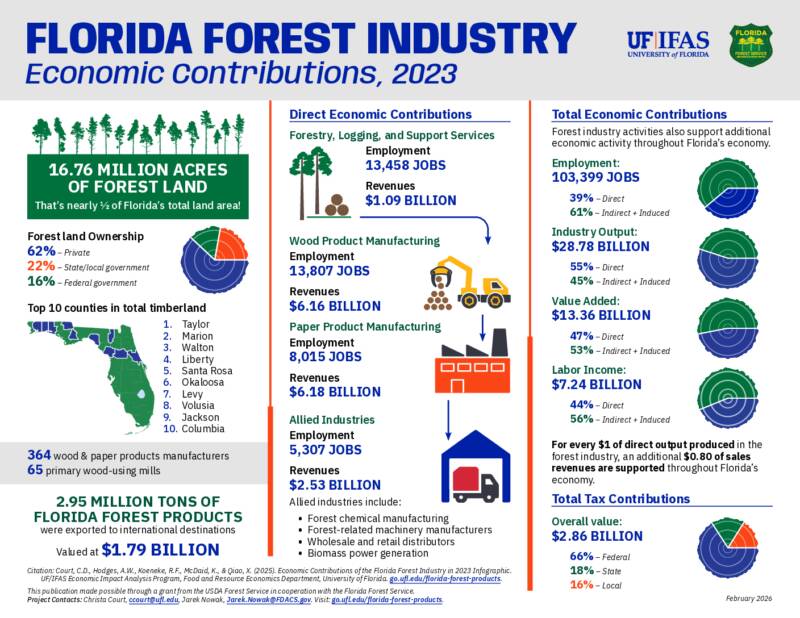
UF/IFAS and FFS partnered on a study of forestry's economic contributions. Here are the results.
Land and Landowners
- 48.8% (16.76 million acres) of Florida’s total land area is forest land.
- 62.0% of forest landownership is private, with smaller amounts owned by state and local governments (21.6%), and the federal government (16.3%)
- Total area of timberland available for commercial harvesting was 14.70 million acres
- Over 40,000 individual forest landowners, encompassing 7.8 million acres
- Nearly 71,000 acres of forest land were planted
- Annual forest tree net growth (32.0 million green tons) was about 1.22 times the total removals (26.2 million green tons)
Products
- 14.39 million green tons of softwood and hardwood timber were delivered to mills for products such as pulpwood, saw logs, veneer/plywood, poles, posts, and fuel, with an estimated stumpage value of $295 million
- About 88% of timber volume harvested was from private lands
- 65 primary wood-using mills, including wood energy facilities sometimes co-located with wood product mills
- Forest, wood, and paper products valued at over $1.79 billion were exported to international markets
Direct Employment and Revenues
- Over 2,500 employer establishments operating in forestry production, wood, paper, chemicals and allied equipment manufacturing, wholesale trade, and biomass electricity generation
- Direct employment in the forest industry was 40,894 full-time and part-time jobs
- Overall average wage paid per employee across all forest industries was $76,992
- Direct output (i.e., sales revenues) in the forest products industry was $16.12 billion
Total Economic Contributions
- Total economic contributions were estimated to be 103,399 full-time and part-time jobs, $28.78 billion in industry output, and $13.36 billion in value added
- The largest total employment contributions were in the Wood Product Manufacturing industry group (39,342 jobs) and the Paper Product Manufacturing group (28,547 jobs)
- Government tax contributions generated by the Florida forest industry totaled $2.86 billion, including $1.89 billion in federal taxes, $500 million in state taxes, and $468 million in local county, district, or municipal taxes
- Counties that were critically dependent upon the forest industry, with employment or value added contributions representing over 20 percent of the overall county economy, included Dixie, Liberty, Taylor, Nassau, and Putnam
Economic Contributions of Forest-based Recreation
- Florida has a variety of public forest lands, including National Forests, National Wildlife Refuges, State Forests, Wildlife Management Areas, a State Ranch, and other public forest lands available for recreation, which cover 6.4 million acres and received over 7.8 million visitor-days
- Total economic contributions of recreational spending by nonresident visitors to Florida’s public forest lands were 5,130 jobs, $697 million in industry output, $443 million in value added, and $61 million in indirect business taxes
Ecosystem Services
- Florida forests also provide ecosystem services such as water regulation and supply, soil formation and stabilization, nutrient cycling, and provision of habitat and refugia for pollinator species
- The average aggregate value of select ecosystem services provided by Florida forest lands was estimated to be $41.32 billion, annually
Visit an interactive dashboard highlighting forest land area, timber production, and the economic contributions of the forest industry across Florida’s counties. Through the maps and charts, explore how Florida’s forests sustain local economies, provide renewable resources, and connect natural landscapes with thriving industrial and community sectors.